TRADE GUIDE
HVAC
Rates by state, licensing requirements, and free tools to quote, invoice, and get paid.
The complete guide for HVAC technicians on the business side of the trade — what you charge, the license you need in your state, and the free tools to quote, invoice, and get paid. HVAC technicians earn a median of $61,010 a year, and whether you need a license depends on your state (U.S. Bureau of Labor Statistics, May 2025).
Average HVAC labor rate per hour
We estimate the typical HVAC labor rate at $65–$90 an hour nationally in 2026, based on the latest (May 2025) BLS wage data. That is what a shop bills the customer for an hour of a technician's time, before parts and any service-call fee. Shops in high-cost metros bill more.
How we get it: the median HVAC technician wage is $29.33 an hour (U.S. Bureau of Labor Statistics, Occupational Employment and Wage Statistics, May 2025). A shop bills about 2.2 to 3.0 times the wage to cover payroll costs, the truck, tools, insurance, licensing and profit: $29.33 × 2.2 = $64.53 and $29.33 × 3.0 = $87.99, rounded to the nearest $5 gives $65–$90. The 2.2–3.0 multiplier is our planning assumption, not a BLS figure.
Labor rates follow local wages: the state median HVAC wage runs from $23.13 an hour in Arkansas to $40.57 in the District of Columbia. Pick your state below for local billed rates. For what homeowners are quoted, including service-call fees and metro and certified-tech rates, read the homeowner's guide to HVAC hourly rates.
HVAC rates & licensing by state
Pick your state for real hourly-rate data (from the U.S. Bureau of Labor Statistics) and the license you need — all 50 states:
- Alabama — rates · licensing
- Alaska — rates · licensing
- Arizona — rates · licensing
- Arkansas — rates · licensing
- California — rates · licensing
- Colorado — rates · licensing
- Connecticut — rates · licensing
- Delaware — rates · licensing
- Florida — rates · licensing
- Georgia — rates · licensing
- Hawaii — rates · licensing
- Idaho — rates · licensing
- Illinois — rates · licensing
- Indiana — rates · licensing
- Iowa — rates · licensing
- Kansas — rates · licensing
- Kentucky — rates · licensing
- Louisiana — rates · licensing
- Maine — rates · licensing
- Maryland — rates · licensing
- Massachusetts — rates · licensing
- Michigan — rates · licensing
- Minnesota — rates · licensing
- Mississippi — rates · licensing
- Missouri — rates · licensing
- Montana — rates · licensing
- Nebraska — rates · licensing
- Nevada — rates · licensing
- New Hampshire — rates · licensing
- New Jersey — rates · licensing
- New Mexico — rates · licensing
- New York — rates · licensing
- North Carolina — rates · licensing
- North Dakota — rates · licensing
- Ohio — rates · licensing
- Oklahoma — rates · licensing
- Oregon — rates · licensing
- Pennsylvania — rates · licensing
- Rhode Island — rates · licensing
- South Carolina — rates · licensing
- South Dakota — rates · licensing
- Tennessee — rates · licensing
- Texas — rates · licensing
- Utah — rates · licensing
- Vermont — rates · licensing
- Virginia — rates · licensing
- Washington — rates · licensing
- West Virginia — rates · licensing
- Wisconsin — rates · licensing
- Wyoming — rates · licensing
Pay ranges widely by state — the national median is $29.33/hour, and the top 10% of HVAC technicians earn over $46/hour ($95,000+ a year).
Common HVAC jobs & what they cost
Typical national price ranges for common HVAC jobs, covering labor plus materials. Local prices vary — use the state rate pages above for figures near you.
- Service call / diagnostic — $75–$150
- AC tune-up / maintenance — $100–$250
- Refrigerant recharge — $150–$450
- Capacitor / part replacement — $150–$500
- Central AC replacement — $3,500–$7,500 installed
- Furnace replacement — $3,000–$6,500 installed
- Full system replacement — $5,000–$12,000 installed
- Ductwork repair — $300–$1,000
- Thermostat installation — $150–$400
- Mini-split installation — $2,000–$5,000
Do HVAC technicians need a license?
It depends on your state. Some states require HVAC technicians to hold a state license; others regulate the work locally, or not at all. License names and thresholds vary, so check your state above for the exact requirement before you bid work.
Need your EPA 608 card?
Every HVAC technician who maintains, services or repairs stationary air-conditioning or refrigeration equipment in a way that could release refrigerant needs EPA Section 608 certification (40 CFR 82.161). Take a free practice test for Core, Type I, II or III, with an explanation and a cited source for every answer: free EPA 608 practice tests.
Free HVAC tools & templates
- HVAC invoice template
- HVAC estimate template
- Free invoice generator
- Estimate generator
- Profit-margin calculator
Invoice and get paid faster with BIG INVOICE
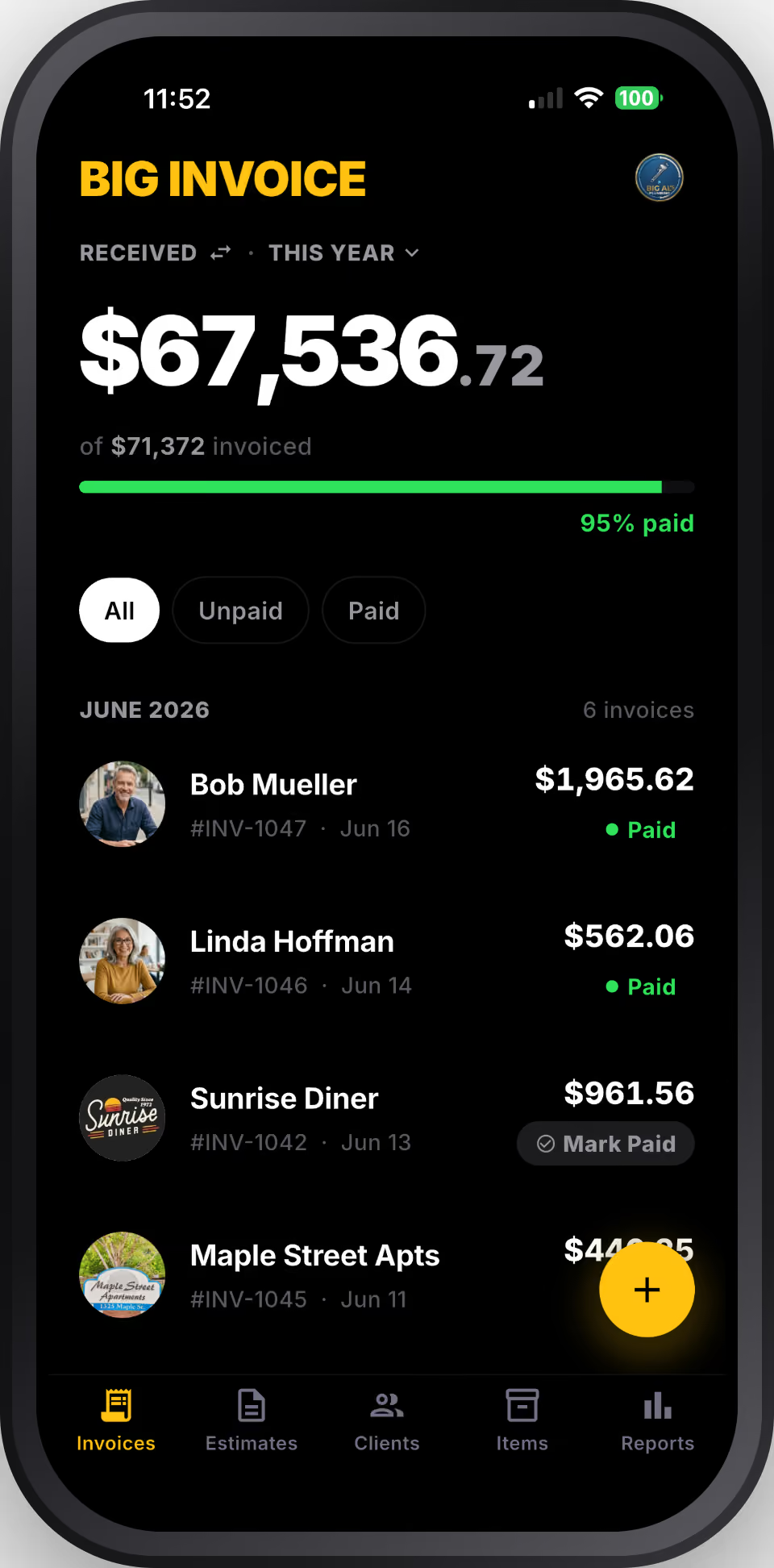
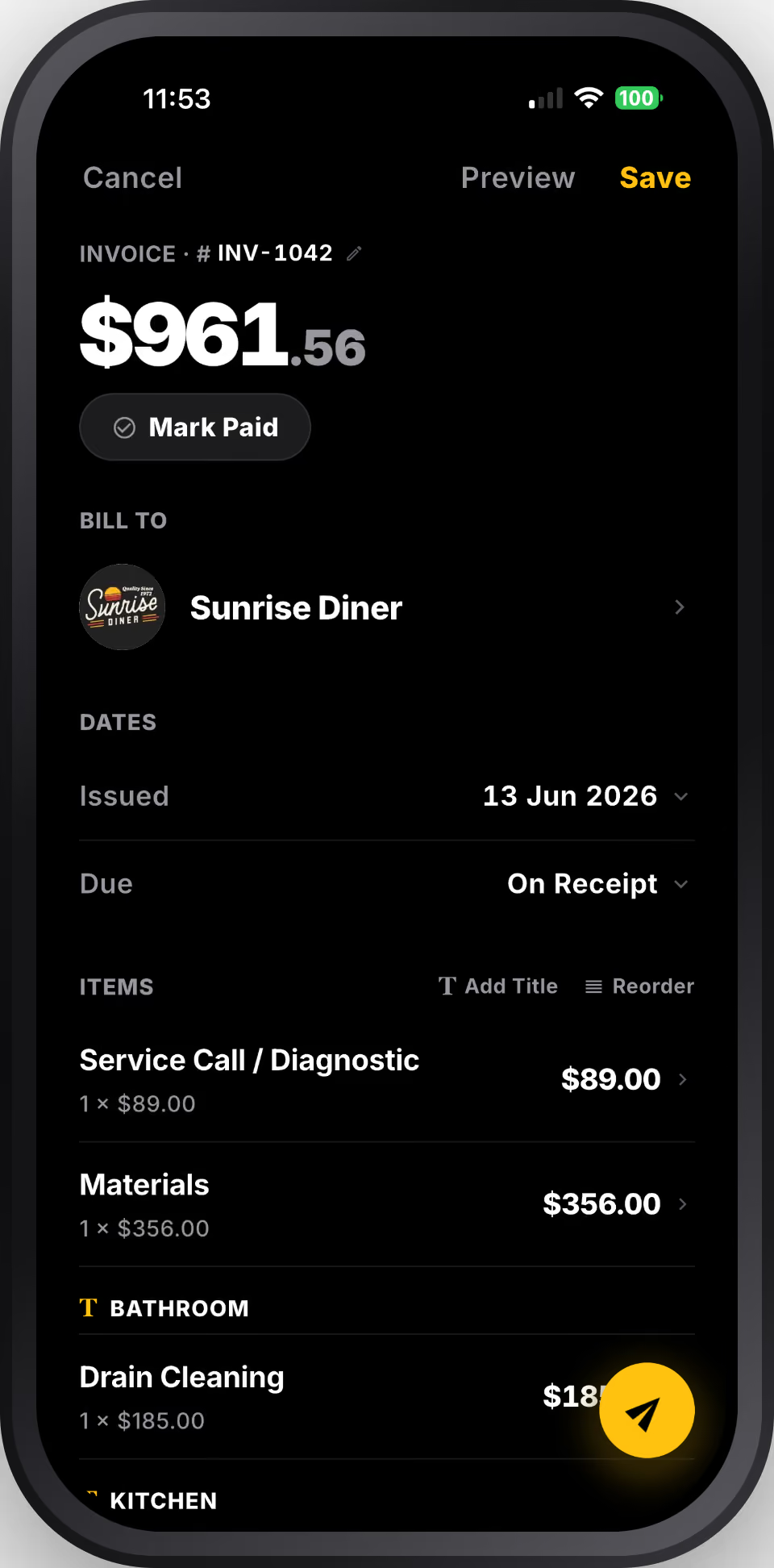
HVAC technicians don't invoice from a desk. BIG INVOICE lets you build a professional invoice on the job site and send a PDF before you've packed up — your client gets it in under a minute, and you get paid faster. No seat fees, no learning curve.
Estimates, clients, and reports in one app
Write an estimate, get approval, and convert it to an invoice in one tap. Track every client's history and see what you're owed at a glance. Your first 2 documents are free; Pro is $5.99/mo or $59.99/yr for unlimited.
HVAC technician FAQ
What is the average HVAC labor rate per hour?
About $65–$90 an hour nationally, by our estimate: 2.2 to 3.0 times the $29.33 median HVAC technician wage (U.S. Bureau of Labor Statistics, May 2025), to cover overhead and profit. Rates are higher in high-wage states and metros.
How much do HVAC technicians charge?
A service call / diagnostic typically runs $75–$150, and bigger jobs like full system replacement run $5,000–$12,000. Billed rates vary by state — see HVAC rates by state above.
How much do HVAC technicians make?
The median HVAC technician earns $61,010 a year ($29.33/hour); the top 10% earn over $95,000 ($46/hour), per the U.S. Bureau of Labor Statistics (May 2025). Pay varies widely by state.
Can an HVAC technician make $100,000 a year?
The top earners get close — the top 10% of HVAC technicians earn around $95,000 a year, and six figures is realistic once you run your own business and bill at contractor rates instead of an hourly wage.
Is being an HVAC technician a good career?
HVAC technicians earn a median of $61,010 a year, with the top 10% earning $95,000. Demand for skilled trades is steady, and pay climbs as you gain experience, specialize, or start your own business — a solid path for people who'd rather work with their hands than sit at a desk.
Do HVAC technicians need a license?
It depends on the state — some require a state license, others regulate HVAC work locally. Check your state's licensing page above for specifics.
How do you become a HVAC technician?
Most HVAC technicians start with hands-on experience — often an apprenticeship or a trade-school program — then get licensed in the states that require it. How long it takes and what's required vary by state; see your state's licensing details above.
Is being an HVAC technician hard?
HVAC technicians work is physical and hands-on, and no two jobs are identical — so practical problem-solving and careful measuring matter more than advanced math. Most HVAC technicians find the trade demanding but very learnable, and the pay and independence make it worth it.
How do HVAC technicians invoice and get paid?
Most solo HVAC technicians and small crews invoice on-site from their phone the moment the job is done. BIG INVOICE creates a professional PDF in under a minute, with your own payment details attached — no in-app fees, and your first 2 documents are free.
Related trades: electricians, carpenters, plumbers, and roofers.
Looks as clean as the work you do.
Ready to get paid faster?
Download BIG INVOICE free. No trial. No credit card. No catch.
Download for iOS